



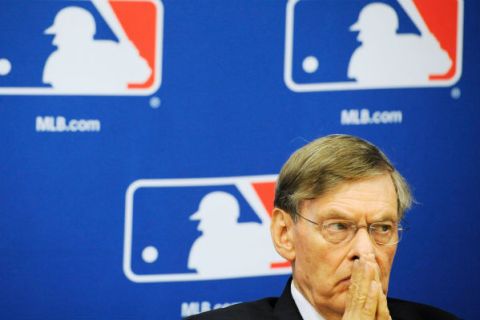
Major League Baseball Commissioner Bud Selig attends a news conference at MLB headquarters on November 22, 2011.
Three cheers for baseball.
While the NFL forced fans to endure a 132-day lockout this spring and summer, and the 2011-2012 NBA season looks doomed because of rancor between its owners and players, on Tuesday Major League Baseball and its players’ union announced that they have agreed to a five-year labor deal. Baseball will now be lockout/strike-free from 1995 through 2016.
“Nobody back in the 70s, 80s, and early 90s, 1994, would ever believe that we would have 21 years of labor peace,” said MLB commissioner Bud Selig.
Normally, such chest-thumping by sports leagues is a PR ploy. But this case, Selig is right. Selig has now overseen three straight deals (2002, 2006, 2011) that did not require a work stoppage. Between 1972 and 1994, all eight negotiations were marred by work stoppages.
What’s new in this collective bargaining agreement? The most significant addition is blood testing for HGH. For years, the baseball union has resisted this. Blood tests require invasive needles. The unspoken worry: blood testing is the only reliable way to catch HGH users.
(MORE: Why Baseball Is Avoiding Other Sports’ Labor Woes)
All players will be subjected to HGH tests in spring training, and for “reasonable cause” throughout the year. Players will be subject to random, unannounced blood testing beginning next off-season. According to this agreement, “the parties have also agreed on a process to jointly study the possibility of expanding blood testing to include in-season collections.” Union chief Michael Weiner said he still has concerns that in-season will drain the players’ energy and negatively effect performance.
(MORE: NBA Lockout And The Economy: An Overstated Impact)
So it’s not a perfect testing system, since the union still has an out on in-season testing. You can picture a player staying clean in the off-season, and going back on HGH during the season, when the drug actually has a performance to enhance (though such a player could risk a “for cause” test if he suddenly hits 10 home runs in a week). But this new testing protocol is a positive step forward for baseball.
Starting in 2013 at the latest, a second wild card team will be added to the post-season (the league said a decision on whether to add a second wild card to the upcoming season will be made by March 1). The two wild card teams will play a one-game playoff, with the winner moving on to play in the Division Series. Also, the Houston Astros will move to the American League West, starting in 2013, giving each league 15 teams. Inter-league play will take place over the entire season, not just within a few designated weeks.
In order to reign in excessive signing bonuses for draft picks, each team will be assigned a signing bonus pool for their first 10 picks on the draft. The value of the pool depends on a team’s draft position (underperforming teams with high draft positions will have bigger pools). Teams that spend above the pool will be taxed, harshly: teams that spend over 15% of their assigned value, for example, will be taxed 100% on the overage, and forfeit first round picks for the next two drafts.
The current luxury tax system will stay in place: teams that spend above $178 million on payroll – we’re looking at you, New York Yankees – pay a penalty. We like the new rule preventing players from flaking on the All-Star game: participation “will be required unless the Player is unable to play due to an injury or is otherwise excused by the Office of the Commissioner.” We hate that the All-Star game still determines home field advantage in the World Series. We’re kinda bummed that instant replay will only be expanded to include fair/foul and “trapped ball” plays. Why not take a few seconds to correct out-safe calls? If poor Armando Galarraga would have thrown that 2010 perfect game for Detroit in 2013, only to have a blown call at first base take it away, he still would have no recourse.
Overall, the new agreement keeps baseball on the right economic path. But most importantly, it keeps the sport on the field. What an embarrassment that the NBA can’t say the same.
Sean Gregory is a staff writer at TIME. Find him on Twitter at @seanmgregory. You can also continue the discussion on TIME’s Facebook page and on Twitter at @TIME.