



REUTERS/Rebecca Cook
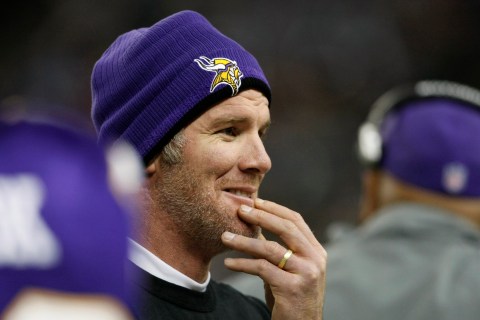
The guy on the sideline, with the beanie and gray stubble, at times looked bored, and at other times happy he wasn’t the one out there getting pounded on the football field. Now that Brett Favre’s streak of starting 297 straight games, dating back to September of 1992, is history, it’s only fair to wonder: did we take his astounding record for granted?
We probably did. In part, Favre is to blame. Since he “retired” at the end of the 2007 season, his annual “to play or not to play” dramas grew tiresome, and seemed egotistical. He skipped the dog days of training camp, which betrayed his working-man image. How many Americans can afford to skip the unpleasant days on the job, and just clock in for the good stuff? Many fans just wished the streak, and Favre, would go away.
(See Brett Favre’s top 5 retirement ramblings.)
But he didn’t, and Favre’s number of consecutive starts ballooned to 297, before a sprained sternoclavicular joint forced him to sit out Minnesota’s game against the New York Giants, which was played in Detroit after snow caused Minnesota’s domed stadium to collapse Sunday morning. But before last night, how many fans could easily recall how many straight games Favre had played, like they instantly remember magic numbers in other sports, such a Lou Gehrig’s original Iron Man streak, 2,130 straight games? Wally Pipp, the man who played first base for the New York Yankees before Gehrig took over, for a generation, is so well-known that he became a verb. Workers are afraid to miss a day in case a young upstart takes their place and does a better job: you don’t want to get “Wally Pipped.” Don Majkowski, the man whose injury paved Favre’s way in Green Bay, hasn’t reached such cultural resonance. No old sap is getting Majkowskied.
(Is Favre’s true legacy bad sportsmanship?)
Cal Ripken played 2,632 straight games for the Baltimore Orioles. That streak is revered; the night Ripken passed Gehrig back in 1995 became a national celebration – even the President showed up. But wasn’t Favre’s streak much more difficult to pull off? What’s harder: standing on a baseball field for an hour or two, everyday, playing shortstop, or lining up under center once a week in football, where very large men are paid very large sums of money to knock you out of the game? Favre’s body got buried in the turf every game, but he kept bouncing back up. He played with broken bones. He took a mental pounding too: Favre played one of the best games of his career, back in 2003, the day after learning that his father had died.
No disrespect to Ripken: in a daily endeavor like baseball, there’s certainly more opportunities for a freak accident that could stall such a streak. But baseball has always been a sport that overvalues its numbers. Since it is played at a slower pace than other games, there’s more time to ruminate on individual feats. So let’s give Favre his due; he’s the ultimate Iron Man in pro sports history.
After the game, Favre talked about the numbness in his hand – it looked as purple as his Vikings uniform – and didn’t seem to eager to return to the field. With just three more meaningless games left in the season for Minnesota, the Vikings need to give lesser lights like Tarvaris Jackson and Joe Webb a chance, to see if they can quarterback the team next year.
It sure sounds like Favre has played his last game. Let’s hope that’s the case too.