

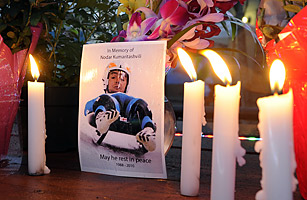
It was the single moment that will forever cloud the Vancouver Olympics. During a training run on Feb. 12, just hours before the start of the Opening Ceremonies, the luge sled of Nodar Kumaritashvili struck the inside wall of the final turn of the Whistler track. Kumaritashvili, who hailed from the former Soviet republic of Georgia, was catapulted into a steel support column and died, at the age of 21. The accident called both the track’s design, and the tactics of the host country, into question. Many luge athletes had openly wondered if the fastest track in the world was too dangerous, and why Canada had not offered other country’s athletes more access to test it in the run-up to the Olympics. In the aftermath of the tragedy, Kumaritashvili’s father said his son had expressed fear about the track. Olympic officials only made matters worse by quickly declaring that the accident was caused by the luger’s own errors, not by any problems with the track itself. (See pictures of the luge tragedy.)
Still, several adjustments were made — the starts were pushed farther down the track and a protective wall was added to the sharp final turn — and the luge competition went on as planned. But the track still gave athletes trouble in other sliding sports. Great Britain’s Paula Walker and Kelly Thomas miraculously walked away from their bobsled crash, in which their sled flipped upside down about halfway down the course and slid all the way to the finish. During the first two runs of the four-man competition, six sleds overturned on the 13th curve, nicknamed “50-50” by American driver Steve Holcomb, a reference to the odds of surviving that bend intact. After seeing all the spills in the bobsled, alpine skiing and the freestyle sports of ski and snowboard cross, you can’t help but wonder: Were we lucky that Winter Olympics tragedy didn’t strike again? Is the gold medal worth all the risk?